Filter press is one of the important equipments in the process of separating solids from liquids and is used in various industries for sludge dewatering, wastewater treatment, separation of suspended particles and filter cake production. Choosing a suitable filter press can have a direct impact on product quality, reducing water consumption, better waste management and increasing the productivity of production lines. Parsian Filter Press, as a producer of all kinds of filter presses in Zanjan, offers industrial solutions tailored to the needs of production, mining, chemical, food and refineries.
Experience in designing industrial equipment, understanding the needs of different industries and paying attention to the quality of construction has made Filter Press Parsian one of the active groups in the field of producing and supplying filtration equipment in Zanjan. The products of this collection are designed and produced with the aim of effective separation, reducing the humidity of the filter cake and creating stable performance in different working conditions.
What is a filter press?
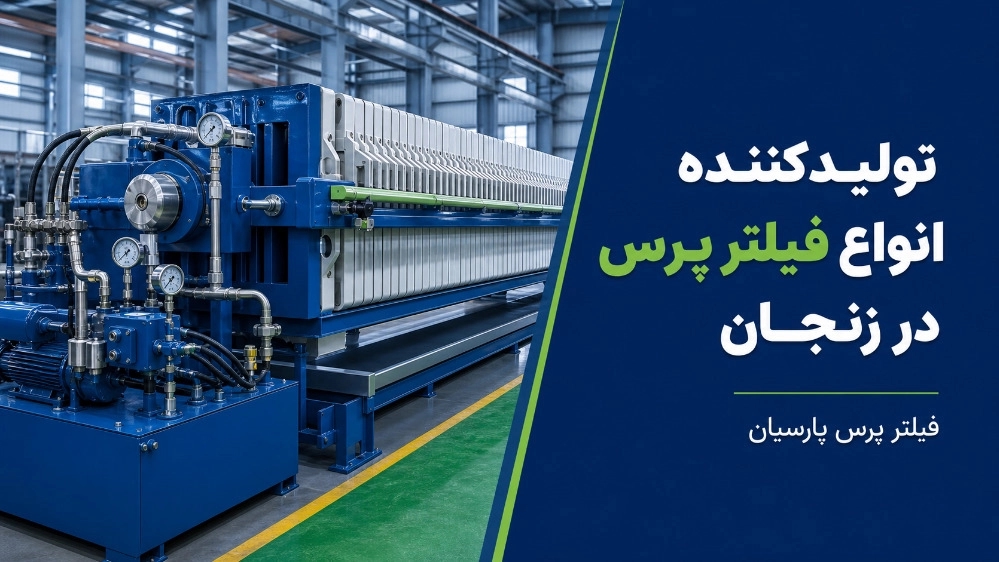
Filter press is an industrial device for separating solid particles from fluid. By passing the slurry or solution containing suspended particles through filter plates and cloths, this device separates the solid part in the form of a compressed cake and removes the purified liquid from the outlet. The filter press consists of a set of plates, filtration fabrics, jack or hydraulic system, chassis, feeding pump and control equipment.
The filtration process in the Parsian filter press is based on the pressure applied to the plates. The slurry enters the chambers between the plates and the liquid passes through the filter cloth. Solid particles remain on the fabric surface and gradually form a compact layer. At the end of the cycle, the plates are separated from each other and the filter cake is discharged.
Persian filter press in Zanjan
Filter Press Parsian, focusing on the needs of industries in Zanjan province and surrounding industrial areas, designs all kinds of filtration equipment for different applications. Mining industries, chemical factories, electroplating units, food industries, paint and resin producers, and groups active in the field of wastewater treatment, need reliable equipment to manage their fluids and waste.
Filter press production in Zanjan provides faster access to consulting, manufacturing, parts supply and support services for regional industries. Direct communication with the manufacturer also reduces coordination time and increases accuracy in equipment selection.
Types of production filter press
Filter presses are divided into different models based on the type of function, plate moving method, capacity, working pressure and cake discharge method. According to the industrial application, Parsian filter press suggests the appropriate model and adjusts the structure of the device according to the project's needs.
Manual filter press
Manual filter press is suitable for workshops, small units and complexes that have a limited volume of input slurry. Opening and closing pages in this model is done with the intervention of the operator. Simple structure, reasonable initial cost and easy repairs are important features of manual filter press.
Hydraulic press filter
Hydraulic press filter applies uniform pressure to the plates using jack and hydraulic unit. This model is suitable for processes where high filtration pressure and stable performance are important. The hydraulic system allows for better pressure adjustment and makes the filter cake more compact.
Automatic filter press
Automatic filter press is suitable for continuous production lines or collections where reducing human intervention is important. In this device, the operation of opening the plates, unloading the cake and preparing the next cycle is done using mechanical and control equipment.
Membrane filter press
Membrane filter press has special plates that apply more pressure to the cake using water or air after the cake is formed. This process reduces the residual moisture in the cake and is used for industries where deep water extraction is important.
Filter Press Parsian investigates the use of membrane plates in projects that need to reduce the final humidity. This model can perform well in industrial wastewater treatment, mining industries and some chemical processes.
Application of filter press in different industries
Filter press is a multipurpose equipment and is used in different separation processes. Parsian filter press suggests suitable equipment for each industry by checking the type of material and process conditions.
Mining industry
In the mining industry, the slurry obtained from washing, mineral processing and particle separation needs dewatering. The filter press can separate water from solid particles and increase the possibility of water reuse. Also, the resulting filter cake can be transferred, stored or used in the next steps of the process.
Industrial wastewater treatment
One of the most important applications of the filter press is the dewatering of sewage sludge. The sludge produced in the treatment process usually has a lot of moisture and it will be expensive to transport or dispose of it without dewatering. By reducing the volume of water in the sludge, the filter press reduces the costs of transportation, storage and disposal.
Filter Press Parsian offers equipment suitable for the amount of sludge, the type of solid materials and the working schedule of the complex for industrial and sanitary treatment plants. Using this device can help to manage waste better and reduce the pressure on the auxiliary units of the refinery.
Chemical industry
In the chemical industry, the separation of sediments, active carbon, catalysts and solid particles from the solution is very important. The filter press must be resistant to chemicals in the process. Choosing the right material for plates, fabric, sealing and piping is one of the important factors in the design of this equipment.
Food industry
In some food units, a filter press is used to clarify liquids, separate particles and dehydrate solids. Compliance with hygiene principles, choosing the right material and the possibility of easy washing of the device are particularly important in this industry.
Filter Press Parsian can suggest a process for food applications, fabric and parts suitable for sanitary conditions. The proper design of the device allows the filtration process to be carried out with the least loss of materials and the most stability.
Paint and resin industries
In the production of paint, resin and coating materials, the removal of solid particles and impurities has an effect on the quality of the final product. The filter press can be used to separate sediments and remaining materials from the solution.
Plating and metalworking industries
Effluent containing heavy metals and suspended particles is produced in electroplating units. Sludge dewatering of these units requires resistant and controllable equipment. The filter press can separate the solids in the sludge and reduce the waste volume.
For this application, Parsian filter press examines factors such as fluid corrosiveness, working pressure and safety requirements. The correct implementation of the filtration process can help to manage wastewater more appropriately and comply with environmental requirements.
Advantages of using Parsian filter press
Choosing the right filter press is not limited to buying a device. Appropriate design, correct installation, operator training and supply of parts also play a role in the final performance. Parsian Press Filter offers a set of services to achieve stable performance.
One of the important advantages of Parsian filter press is the possibility to choose the device based on the actual capacity of the production line. A device whose capacity is less than the set's requirement increases the number of cycles and decreases the production speed. A device whose capacity is more than required also increases the initial cost and occupied space. A careful examination of working conditions creates a more economical choice.
The quality of filter plates and fabrics is another important factor in the device's performance. Resistant plates and proper sealing prevent grout leakage. A suitable filter cloth also allows better passage of liquid and uniform cake formation. According to the type of material, Filter Press Parsian suggests the right fabric for each project.
Access to maintenance services is one of the benefits of working with a domestic manufacturer. If there is a need to replace parts, check the hydraulic system or correct the device's performance, the communication with the manufacturer is done faster. Parsian Filter Press can play a role in reducing production line stoppages by providing technical guidance.
The main components of the filter press
Each filter press consists of different components, the coordination between which determines the device's performance. The main chassis, filter plates, fabrics, hydraulic or mechanical system, feed pump, output manifold and control panel are important parts of the device.
The chassis must have enough strength to withstand the pressure of the plates and the weight of the filter cake. Plates should also be resistant to pressure, chemicals and environmental conditions. Filter fabrics are selected based on particle size and fluid characteristics. The feed pump is responsible for transferring the slurry to the filter chambers.
Parsian filter press takes into account the coordination between these components during the construction of the device. The use of suitable parts and accurate assembly will reduce leakage, increase the life of the device and improve the quality of water extraction.
Factors affecting the choice of filter press
To choose a filter press, the process specifications must be carefully checked. Slurry volume, percentage of solids, type of particles, viscosity, fluid temperature, corrosiveness, required pressure, and the target humidity of the cake are effective factors.
The number of plates and the dimensions of the plates determine the capacity of the device. The larger the volume of the chambers, the more slurry is processed per cycle. The type of fabric also affects the flow rate of the liquid and the quality of the cake. In some applications, fabric with dense texture and in some processes, fabric with higher permeability is suitable.
Filter Press Parsian checks the process information before providing a technical proposal. This work prevents the incorrect selection of the device and makes the final equipment to be in harmony with the actual needs of the factory.
Maintaining and increasing the life of the filter press
Regular inspection of plates, cloths, fittings, hydraulic jack and feed pump is necessary to maintain filter press performance. Damaged fabrics should be replaced in a timely manner to prevent solid particles from passing through and reducing the filtration quality.
Cleaning the fabric after the end of the cycles prevents clogging of the pores. Excessive pressure can also damage the plates and the sealing system. The operator must adjust the device according to the technical instructions and take serious signs such as leakage, pressure drop or reduction in filtration speed.
Why Parsian press filter is the right choice?
Parsian filter press, focusing on the production of all kinds of filter presses in Zanjan, tries to provide products that suit the real needs of industries. Knowing the industrial conditions of the region, the possibility of direct consultation, paying attention to the quality of construction and technical support are important factors in choosing this collection.
Customers can discuss information about capacity, fluid type, solids percentage and installation conditions with Parsian filter press experts before purchasing. Examining this information helps to choose the right model and reduce side costs.
Filter Press Parsian, in addition to manufacturing the machine, also supports customers in selecting parts, determining the number of plates, selecting filter fabric, and providing maintenance solutions. The aim of this collection is to provide a device that has stable and acceptable performance in real working conditions.
Buy filter press in Zanjan
Purchasing filter press in Zanjan for the mining, chemical, food, electroplating and refineries industries has a favorable result when the project needs are accurately determined before ordering. Inlet capacity, installation space, pump type, degree of automation and cake discharge method should be checked in the design stage.
Filter Press Parsian is ready to provide advice for the selection and production of filtration equipment in Zanjan. Customers can get a more suitable solution by announcing the fluid and process specifications. The exclusive design makes the device compatible with the production line in terms of capacity, dimensions and accessories.
Using standard filter press reduces sludge moisture, increases water recovery, better waste management and improves process quality. Parsian Filter Press offers a practical solution for separating solids from liquids by producing equipment tailored to the needs of industries.
summary
Filter press is one of the key equipment for sludge dewatering and separating solids from liquids. This device is used in mining, sewage treatment, chemical, food, paint, resin, electroplating and many production units. Choosing the right model should be done based on the type of fluid, working capacity, filtration pressure, amount of solids and target humidity.
Parsian Filter Press, as a producer of all kinds of filter presses in Zanjan, offers manual, hydraulic, automatic and membrane equipment for various applications. Appropriate design, paying attention to the quality of parts, the possibility of technical support and understanding the needs of industries, has made this collection a suitable option for providing filtration equipment.
In order to receive advice and choose the right filter press, it is very important to check the process specifications and installation conditions. Parsian filter press can provide a suitable solution for increasing productivity, reducing operating costs and improving waste management based on the needs of each complex.